What you can see on the Prawle Point webcam
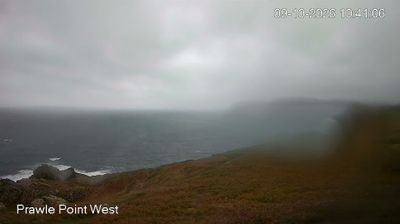
From the lookout, the land falls away through bracken to the rocks, and the coast runs west in a line of headlands with the open Channel beside it. White horses, breaking waves and approaching showers are easy to read from this height, often well before the weather reaches inland. A time-lapse of the same view plays back the last 24 hours, for a look at the whole day at once.
Prawle Point webcam: the coast west of Devon's southern tip
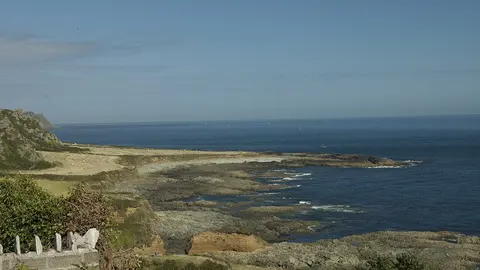
Prawle Point is the southernmost point of Devon, and the volunteers of the National Coastwatch Institution keep a lookout there. This is their west-facing camera. It looks over slopes of bracken and grass to the rocks at the water's edge, then along the coast to a long headland in the distance, with the sea filling the left of the picture.
So exposed a spot makes it a good gauge of conditions on this stretch of coast: white horses and breaking waves show the wind and the sea at a glance, and showers can be seen coming in long before they arrive. Late in the afternoon the sun moves round in front of the camera.
The lookout hill
The name comes from the Old English Prǣwhyll, "lookout hill", and the headland still lives up to it: the National Coastwatch Institution keeps a station here, staffed by volunteers who watch over this part of the Channel. Many ships have been wrecked on these rocks. The tea clipper Lalla Rookh struck Gammon Head, just to the west, and her remains lie under the sand of Elender Cove. In December 1992 the ship Demetrios broke free from her tow in a gale and was driven onto the rocks, breaking her back within hours; crowds came for weeks to see her, and some of the wreckage is still visible. The point lies within a Site of Special Scientific Interest that runs east to Start Point, and is known for the cirl bunting, a bird found in only a few parts of Britain, and for rare migrant birds blown in from across the sea.
When to watch Prawle Point
The view looks west, so the morning and midday light is the clearest, and by late afternoon the sun is shining towards the camera. South-westerly gales bring the biggest seas onto this exposed coast and fill the view with white water. In spring and autumn, the seasons of migration, birdwatchers come to the headland looking for rarities.
Visiting Prawle Point
A single-track road from the village of East Prawle ends at a National Trust car park, and the point is a short walk from there along the South West Coast Path. The cliffs are high and steep, so keep to the path.
Around Prawle Point
East along the coast, past Start Point and Start Bay, is the Dart estuary at Dartmouth. To the west lie the Salcombe estuary and, further on, the city and the Sound of Plymouth.