
What you can see on the Hornsea webcams
One view runs north along the sea wall and the beach, the other south over the promenade and its line of wooden groynes, so together they cover the shore on both sides of the lookout. They show at a glance whether there is sand to walk on or the sea is up against the wall, and the 24-hour time-lapses let you follow the tide covering and uncovering the groynes over a whole day.
Hornsea beach webcam: the sea wall and the north beaches
The National Coastwatch Institution, whose volunteers keep watch over the shore, has a lookout on Hornsea seafront, and this is one of its cameras, labelled on screen with its bearing of 035°, roughly north-east. It looks along the promenade and sea wall to the north, over a groyne and the beach to the open North Sea, with part of a flag hanging into the top corner of the picture.
At high tide the sea comes right up against the wall, the surf washes over the groyne and foam covers the beach; at low tide a wide stretch of sand opens up. That is what it is good for: seeing whether there is any beach to walk on and how big the waves are before you go down.
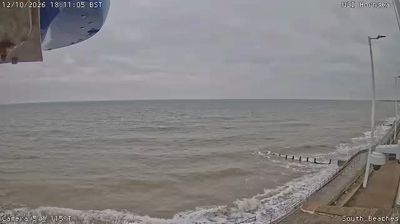
Hornsea south beach webcam: the groynes and the promenade
The second camera at the National Coastwatch lookout turns the other way, on a bearing of 115°, a little south of east. It looks down the line of the promenade to the south, with its railings, lamp posts and steps on the right, a row of wooden groynes running out into the sea and the beach curving away along the southern end of town.
The groynes are the thing to watch: when the tide is up the waves break right over them and the sea reaches the foot of the promenade, and as it falls the sand reappears between them. Together with the north camera it gives a full picture of the shore on both sides of the lookout.
A coast that keeps moving
Holderness is built of soft glacial clay, and its coast is among the fastest-eroding in Europe, retreating on average by well over a metre a year; at least 23 towns and villages along it have been lost to the sea over the centuries. Hornsea holds its line thanks to the defences in front of the town: groynes and a concrete sea wall built in the years after 1906, lengthened in 1923 and extended south in 1930. Just inland, the Mere is about 2 miles long and covers some 470 acres; it is protected for its birds and used for sailing, rowing and fishing. The town also gave its name to Hornsea Pottery, made here from 1949 until 2000, and its seafront marks the eastern end of the Trans Pennine Trail, the path for walkers and cyclists that crosses the country from Southport.
When to watch Hornsea
The coast faces east, so in summer the sun rises over the North Sea in front of the lookout and the early light is good on both views; by afternoon the sun is behind the town. High tide is the time to see the sea at its liveliest against the wall, especially in winter, when onshore winds from the north and east raise the biggest waves. At low tide the beach is wide and sandy, the best time for a walk along it.
Around Hornsea
Bridlington, with its harbour and South Bay, is about 12 miles up the coast. Inland, Beverley and Hull are both within 15 miles, and York a little under 40 miles away.